
Wondering if it's safe to fly with an ear infection? Learn the real risks, when to avoid it, and how to protect your ears if you must travel.


A viral infection is an illness caused by a virus, such as a cold, flu, COVID-19 or norovirus. Most are mild and clear up on their own, usually within one to two weeks. Antibiotics do not work on them. Rest, fluids and a pharmacist’s advice on pain relief are the usual treatment.
See a GP if a high temperature lasts more than three days, you are not improving after seven to ten days, or a cough lasts more than three weeks. Call 999 for severe breathing difficulty, sudden chest pain, confusion or a rash that does not fade when pressed.
| Question | Answer |
|---|---|
| What causes it? | A virus, not bacteria |
| How long does it last? | Most respiratory infections pass within 1 to 2 weeks |
| Do antibiotics help? | No. They only treat bacterial infections |
| Best home care | Rest, plenty of fluids, paracetamol or ibuprofen as the packet directs |
| See a GP if | High temperature for more than 3 days; no improvement after 10 days (cold) or 7 days (flu); cough for more than 3 weeks |
| Call 999 if | Severe breathing difficulty, sudden chest pain, confusion, blue or blotchy skin, a rash that does not fade |
| Sick note needed? | Only after 7 days off in a row; before that you self-certify |
| Facts last checked | 21 November 2026 |
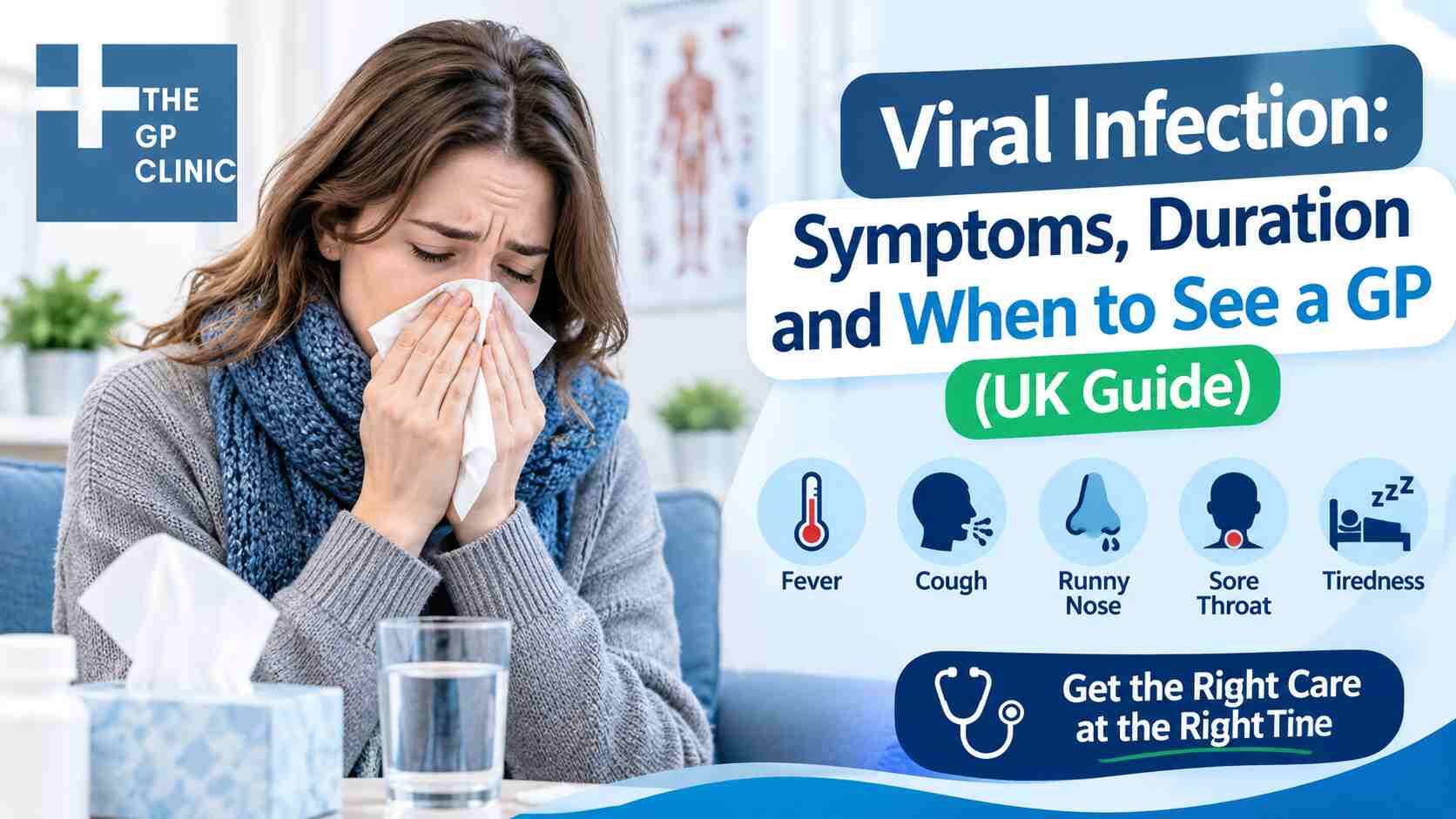
A viral infection happens when a virus gets into your body, multiplies inside your cells and triggers an immune response. The fever, aches, cough and tiredness you feel are largely your immune system doing its job.
Viruses and bacteria are different organisms, and the difference decides the treatment.
| Viral infection | Bacterial infection | |
|---|---|---|
| Cause | A virus | Bacteria |
| Antibiotics | Do not work | Can work, if the GP decides they are needed |
| Typical examples | Common cold, flu, COVID-19, norovirus, bronchiolitis | Impetigo, cellulitis, kidney infection, pneumonia |
| Usual outcome | Clears on its own while the immune system fights it | May need treatment to clear, or to prevent complications |
The NHS 111 Wales antibiotics page gives these examples of bacterial conditions: acne, impetigo, chlamydia, kidney infection, cellulitis and pneumonia.
You often cannot tell the two apart from symptoms alone. UKHSA guidance says COVID-19, flu and other respiratory infections look alike, so symptoms cannot identify which one you have. That is why the useful question is not “which virus is it?” but “how am I changing over the next few days?”. The checkpoints below answer that.
Most respiratory viral infections pass within one to two weeks, according to the NHS. The exact timing depends on the virus.
| Infection | Key timing |
|---|---|
| Common cold | Feel better in about 1 to 2 weeks. Symptoms build over 2 to 3 days. Infectious until symptoms have gone |
| Flu | Starts suddenly. Get advice if not improving after 7 days. Most infectious in the first 5 days |
| Bronchiolitis (babies and under-2s) | Worst on days 3 to 5. The cough usually eases within about 3 weeks |
| Norovirus (vomiting and diarrhoea) | Most people recover in about 2 to 3 days (NHS Essex ICB). Stay off work, school or nursery until 48 hours after the vomiting and diarrhoea have stopped |
| Chickenpox | Stay away from school or nursery until 5 days after the rash first appears |
Sources: NHS pages on the common cold, flu and bronchiolitis, and the GOV.UK exclusion periods.
The 3-7-10-21 checkpoints. Rather than asking “is this normal?” every day, use four dates from NHS advice:
| Day | What to check | Then |
|---|---|---|
| 3 | Is your high temperature still there? | See a GP |
| 7 | Have flu symptoms improved? | If not, get advice from a GP or NHS 111 |
| 10 | Are cold symptoms still no better? | See a GP |
| 21 | Do you still have a cough? | See a GP |
Lingering tiredness or a cough after you recover does not necessarily mean you are still infectious, according to UKHSA. But a cough past three weeks is a reason to be checked.
Common symptoms include:
The pattern tells you more than any single symptom.
| Cold | Flu | |
|---|---|---|
| Onset | Builds over 1 to 3 days | Appears within hours |
| Where it hits | Mainly nose and throat | Whole body |
| Daily life | You can usually carry on | You can feel too exhausted to carry on normally |
This comparison follows the NHS flu page and cold page.
Signs it may not be “just a virus”. Severe symptoms may point to pneumonia, which needs a GP’s assessment. A GP may prescribe antibiotics for a bacterial infection. If you feel very unwell or you are getting worse, do not wait for a checkpoint date; use the red-flag table below.
| Illness | Typical course | Get help when |
|---|---|---|
| Chest infection or viral bronchitis (adults) | Symptoms usually better in 7 to 10 days. Cough and mucus can last up to 3 weeks | Cough over 3 weeks, coughing up blood, feeling very unwell, or you are pregnant, over 65 or have a weakened immune system |
| Sore throat (children) | A cold-related sore throat may last a day or 2; most get better within a few days | GP if it lasts over 3 days, or high temperature and unwell. 999 or A&E if your child cannot swallow fluids or saliva, or has trouble breathing |
| Ear infection (children) | Most get better within about 3 days | GP if earache has not improved after 3 days |
| Croup (children) | Barking cough and a harsh sound breathing in; usually treated at home | 999 or A&E if severe and your child is struggling to breathe |
| Norovirus | Most recover in about 2 to 3 days | NHS 111 if you cannot keep fluids down, vomiting lasts over 2 days or diarrhoea over 7 days. 999 or A&E for blood in vomit, a stiff neck or severe abdominal pain |
Sources: NHS pages on chest infection and colds, coughs and ear infections in children, and NHS Essex ICB on norovirus.
COVID-19. It shares symptoms with colds and flu, so you cannot tell them apart without a test. Testing, isolation and treatment rules have changed since 2022, so check the current NHS COVID-19 page rather than relying on an old day count.
No. The NHS states: “Antibiotics do not work for viral infections such as colds and flu, and most coughs.” They kill bacteria or stop them spreading, and a virus is not a bacterium.
That is why GPs do not usually prescribe them for these illnesses. The NHS adds that antibiotics are no longer routinely used for chest infections, ear infections in children or sore throats.
Taking them when you do not need them has a cost. It can make them less effective for you later, and overuse has contributed to resistant bacteria such as MRSA and C. difficile.
If you were hoping for antibiotics, these questions keep the conversation useful:
The last one gives you a clear trigger for coming back, which is more valuable than a prescription that will not help.
If a GP does prescribe antibiotics for a bacterial infection, the NHS says to complete the course as advised, even if you feel better.
There is no cure for most viral infections, so treatment means helping your body while it recovers.
The NHS says there is little evidence that vitamin C, echinacea or garlic prevent colds or speed recovery.
Ask a pharmacist first. A pharmacist can advise on pain relief, decongestants and nasal sprays. The NHS says decongestants are not for children under 6 and nasal sprays should not be used for more than a week.
Do not give to children:
A daily four-point check. Once a day, check: temperature, fluids (are you drinking and passing urine?), breathing, and alertness. If any of these is clearly worse than yesterday, move to the red-flag table. This is a practical routine built on the NHS warning signs below, not an NHS tool.
Sources: NHS common cold, flu and respiratory tract infection pages.
Feeling worse than you expected a week or two later is common. Two things linger most.
Cough. The NHS says the cough and mucus from a chest infection can last up to 3 weeks. A cough that lasts more than 3 weeks is a reason to see a GP, for adults and children. In children, a long cough that is worse at night or brought on by running about can be a sign of asthma.
Tiredness. Post-viral fatigue is common after any virus. A Cambridgeshire and Peterborough NHS Foundation Trust leaflet says it usually resolves in up to 4 weeks, and that you should discuss it with your GP if it is still a problem after 4 weeks. That leaflet dates from February 2021, so ask your GP for current advice.
Going back to work. If you are not ready for full days, ask the clinician about a fit note marked “may be fit for work”. GOV.UK guidance lists a phased return, altered hours, amended duties and workplace adaptations as the options, and your employer should discuss them with you.
The NHS advice on getting worse still applies: if symptoms get worse rather than slowly improving, do not wait for the next checkpoint.
| Level | Signs | What to do |
|---|---|---|
| Home care | Mild symptoms that are steady or slowly improving, you are drinking and passing urine, and you can rest | Rest, fluids, pharmacist advice. Use the 3-7-10-21 checkpoints |
| See a GP (non-urgent) | High temperature for more than 3 days; no improvement after 10 days (cold) or 7 days (flu); cough for more than 3 weeks; a long-term condition or weakened immune system; worry about a child | Book a GP appointment. Say how many days you have been ill |
| Urgent GP appointment or NHS 111 | Aged 65 or over, pregnant or just given birth, or a long-term condition, and flu symptoms; feeling very unwell or short of breath; a baby or child you are worried about; sepsis in the past 12 months with signs of infection | Call NHS 111 or ask for an urgent appointment today |
| Call 999 or go to A&E | Sudden chest pain; severe difficulty breathing; confusion or slurred speech; blue, pale or blotchy skin, lips or tongue; a rash that does not fade when pressed; little or no urine for 18 hours | Call 999. Do not drive yourself; ask someone to drive you or ask for an ambulance |
Sources: NHS common cold, flu and sepsis pages.
Coughing up blood. The NHS puts this under 999 symptoms on its flu page and under GP advice on its respiratory infection page. If it comes with chest pain or breathlessness, call 999. Otherwise get same-day advice from NHS 111.
Why sepsis matters in a virus article. Sepsis is a serious reaction to an infection, and it can develop over a few hours. It can follow a virus, so a person who is getting worse fast, or does not seem to be making sense, needs immediate help even if not every symptom is present, according to the NHS. If you or your child had sepsis in the last 12 months and has signs of infection, call NHS 111.
Most children recover from viral infections at home. Babies and young children can also become unwell faster, and they cannot tell you what is wrong.
Babies and children under 5: call 999 or go to A&E for (from the NHS sepsis page):
Bronchiolitis. This is a common virus (usually RSV) in babies and children under 2. Early signs look like a cold. It is usually mild but can be serious, and babies under 6 months, premature babies and children with heart or lung conditions are at higher risk. Symptoms are usually worst between days 3 and 5, and the NHS says to ask for an urgent GP appointment or call 111 if a baby is feeding much less than normal or has had no wet nappy for 12 hours. The NHS bronchiolitis page lists all the signs.
Giving medicine to children. The NHS says children’s paracetamol can be used from 2 months and ibuprofen from 3 months, and not both at the same time. Check the packet or ask a pharmacist for the dose.
Higher-risk adults. The NHS lists people aged 65 and over, people who are pregnant or recently gave birth, people with long-term conditions (such as diabetes, or heart, lung, liver, kidney, brain or nerve conditions), and people with a weakened immune system. If you are in one of these groups and have flu symptoms, get advice early rather than waiting for the checkpoints.
Going to work. The NHS says to stay at home with flu if you have a high temperature, feel hot, cold or shivery, or cannot manage normal activities. UKHSA guidance says to stay home until your temperature has gone, or you no longer feel unwell, and to work from home if you can. It gives no fixed number of days, so go by how you feel.
Going to school or nursery. GOV.UK sets these stay-away periods:
| Illness | Stay away until |
|---|---|
| Flu | Better and no longer has a temperature |
| Vomiting and diarrhoea, including norovirus | 2 days after they have stopped |
| Chickenpox | 5 days after the rash first appears |
| Hand, foot and mouth | No exclusion required |
| Respiratory infections, including COVID-19 | Stay away if more than mild symptoms, for example a high temperature |
Do you need a sick note? Only if you are off for more than seven days in a row, counting weekends and bank holidays. Up to seven days, you self-certify: you tell your employer, and no fit note or other healthcare proof is needed. From day eight, your employer will expect a fit note from a doctor, nurse, pharmacist, physiotherapist or occupational therapist. The assessment can be by phone or video. Full rules: our guide to GP sick notes and our guide to getting a sick note online or by phone.
Sick pay. Since 6 April 2026, Statutory Sick Pay is payable from the first day of sickness for those who qualify. It is the lower of 80% of your average weekly earnings or £123.25 a week, according to Acas. Your contract may pay more.
A practical example. You wake with flu on Monday 23 November. You self-certify from day 1. By Sunday 29 November (day 7), you are still too exhausted to work, so you ask for a fit note to cover the days from day 8 onward. Ask by day 5 or 6, because appointments take time.
Viruses spread through droplets from coughs and sneezes, and from germs on hands and surfaces. The NHS says cold germs can survive on hands and surfaces for up to 24 hours, and you can spread a cold a few days before symptoms appear.
What helps:
Vaccines. The NHS offers the flu vaccine each autumn or early winter to some adults and children at higher risk. It does not prevent colds. The NHS also offers the RSV vaccine from 28 weeks of pregnancy to help protect a baby for its first six months, and says higher-risk people can ask a GP about the pneumococcal vaccine. Check the NHS vaccine pages for current eligibility, because it changes.
What is a viral infection?
A viral infection is an illness caused by a virus, such as a cold, flu, COVID-19 or norovirus. Most are mild and clear up on their own. Antibiotics do not work on them, because they only treat bacteria.
How long does a viral infection last?
Most respiratory viral infections pass within one to two weeks. A cold usually improves in 1 to 2 weeks. Get advice if flu has not improved after 7 days, and see a GP if a cough lasts more than 3 weeks.
Do I need antibiotics for a viral infection?
No. The NHS says antibiotics do not work for viral infections such as colds and flu, and most coughs and sore throats. A GP may prescribe them only if a bacterial infection is suspected.
How can I tell if it is viral or bacterial?
Symptoms alone often cannot tell you, because many infections look alike. A GP can assess you. Get help sooner if you feel very unwell, are getting worse, or have severe symptoms that could mean pneumonia.
How long am I contagious with a viral infection?
For a cold, you can pass it on a few days before symptoms appear and until symptoms have gone, usually 1 to 2 weeks. For flu, you are most likely to pass it on in the first 5 days.
Can I go to work with a viral infection?
Stay at home if you have a high temperature or feel too unwell to do normal activities. If you can work from home, that is an option. There is no fixed number of days, so go by how you feel.
Do I need a sick note for a viral infection?
Only if you are off for more than seven days in a row. Before that, you self-certify. After seven days, your employer will expect a fit note, which a clinician can issue after a phone or video assessment.
When should I worry about a viral infection?
See a GP if a high temperature lasts more than 3 days or you are not improving after 7 to 10 days. Call 999 for severe breathing difficulty, sudden chest pain, confusion, blue or blotchy skin, or a rash that does not fade when pressed.
What can I take for a viral infection?
Paracetamol or ibuprofen for fever and aches, as the packet directs, plus rest and plenty of fluids. Ask a pharmacist about other remedies, and do not give aspirin to anyone under 16.
Is a viral infection the same as flu?
No. Flu is one viral infection. Others include the common cold, COVID-19, norovirus and bronchiolitis. Flu tends to start suddenly and affect the whole body.
How long does a cough last after a viral infection?
The NHS says the cough and mucus from a chest infection can last up to 3 weeks. See a GP if a cough lasts more than 3 weeks, or sooner if you cough up blood, feel very unwell or are short of breath.
Why am I so tired after a viral infection?
Post-viral fatigue is common after any virus. An NHS trust leaflet says it usually resolves in up to 4 weeks. If it is still a problem after 4 weeks, discuss it with your GP.
If you need to see a clinician and your surgery cannot fit you in, The GP Clinic offers online GP appointments. [Owner: confirm wording, price and availability before publishing.]
Medically reviewed by Dr Sulaiman Shah, MBChB BMedSci, MRCGP — General Practitioner and founder of The GP Clinic. Last updated 21 November 2026.