
An in-depth guide to fit notes, explaining their purpose, legal importance, workplace challenges, and return-to-work support.


You do not need a GP sick note for the first seven days of an illness. You tell your employer you are unwell and, when you are back, confirm it yourself. This is called self-certification. From day eight you need a fit note from a healthcare professional.
The seven days are calendar days. Weekends and bank holidays count, even if you would not have worked them.
“Sick note” is what everyone says, but the official document has been called a fit note since 2010. You will see both terms below. They mean the same thing.
Medically reviewed by Dr Sulaiman Shah, MBChB BMedSci, MRCGP — General Practitioner and founder of The GP Clinic.
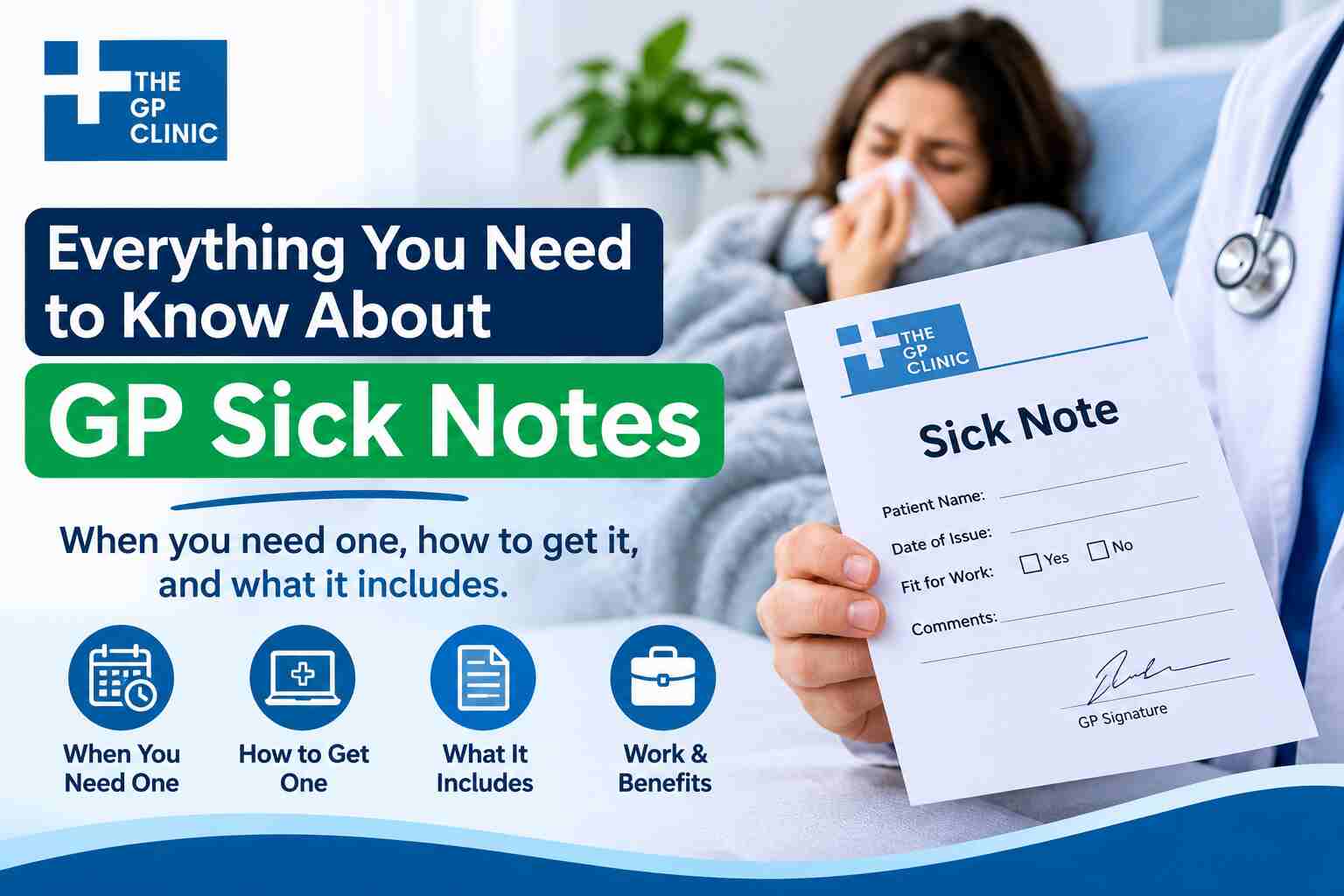
A GP sick note, officially a fit note, is a written statement from a doctor or other registered healthcare professional. After assessing you, they record one of two outcomes: “not fit for work” or “may be fit for work”. You give it to your employer as evidence of illness, mainly so you can receive sick pay after the first seven days.
It is evidence, not permission. Your employer does not approve it. They use it to decide what support or pay applies.
More than GPs can issue one. According to GOV.UK, fit notes can come from:
The professional must assess your fitness for work first. Community pharmacists generally cannot issue one, because they do not have access to the form. Pharmacists working in GP or hospital teams can.
The rule turns on how many days in a row you have been ill.
| Days ill (in a row) | What you need | Sick pay |
|---|---|---|
| 1 to 7 | Self-certification. Your employer may ask you to confirm you were ill, usually by form or email. No fit note or other healthcare proof is needed. | Statutory Sick Pay (SSP) is payable from day one if you qualify |
| 8 or more | A fit note from a healthcare professional | SSP continues if you qualify; your contract may pay more |
| Long-term illness | A new fit note each time the last one ends | A fit note can cover up to 3 months at a time in the first 6 months of a condition |
A worked example. You fall ill on Wednesday 4 November. That is day 1. Day 7 is Tuesday 10 November, so the first day you need a fit note is Wednesday 11 November.
The practical lesson: do not wait for day 8 to start looking. If your surgery has a wait for appointments, ask for one by day 5 or 6. A fit note is free if you have been ill for more than seven days when you ask. For seven days or less, GOV.UK says a fee may apply, which is why most short illnesses are handled by self-certifying.
Ask the practice how long it will take before you book. The note is only useful if it reaches your employer promptly.
What it costs. An NHS fit note is free if you have been ill for more than seven days when you request it. Private services set their own prices, so check before you book.
Many people assume a fit note always means “stay at home”. It does not. The clinician picks one of two outcomes, and the second is easy to miss.
| Not fit for work | May be fit for work | |
|---|---|---|
| What it means | You cannot work for the period stated | You may be able to work with support |
| What it states | How long you cannot work, and whether you can return to your previous role afterwards | Tick-box adjustments plus a comment box on your general fitness for work |
| What your employer does | Treats it as evidence for sick pay | Discusses the suggested changes with you |
The adjustments a “may be fit” note can suggest are:
Here is the part that matters most. Your employer does not have to accept the advice, according to GOV.UK guidance for employers. If you cannot agree on changes, you are treated as “not fit for work” and the same note still counts as evidence for sick pay. You do not need a second note.
How long it lasts. In the first six months of a condition, one fit note can cover a maximum of three months. The clinician may set an earlier review date if your condition is likely to change.
The rules changed on 6 April 2026, so older guides are out of date.
Statutory Sick Pay (SSP). Under the updated rules:
Your contract may pay more than SSP. Check your contract or staff handbook for occupational sick pay.
What your employer can and cannot do.
Holiday. Holiday keeps building up while you are off sick. If illness stops you taking leave, you can carry it into the next leave year. If you fall ill during a booked holiday, you can ask to treat that time as sick leave. Your employer cannot force you to use annual leave while you are eligible for sick leave.
This section covers Great Britain. Northern Ireland has its own sick pay legislation, so check nidirect if you work there.
An illustrative scenario. Priya works in a shop and sprains her wrist on day 1. By day 6 she is still in pain, so she asks for an appointment. The clinician records “may be fit for work” with amended duties: no lifting, till work only. Her manager says the shop cannot cover the lifting tasks. Under GOV.UK guidance, Priya is then treated as “not fit for work” for sick pay purposes, on the same note. She does not need a second one. She receives SSP if she qualifies, or any more generous contractual sick pay.
If you need a fit note and cannot get an appointment in time, The GP Clinic offers online GP appointments and a medical certificates service.
Medically reviewed by Dr Sulaiman Shah, MBChB BMedSci, MRCGP — General Practitioner and founder of The GP Clinic.
You do not need one. For seven days or less, you self-certify. A clinician can still assess you and issue a fit note, but GOV.UK says a fee may apply.
Not without an assessment. It can be by video or phone, or based on a written report from another healthcare professional.
A “not fit for work” note is evidence for sick pay, and your employer should treat it that way. They can decide whether to accept suggested adjustments on a “may be fit” note, but the note still counts for sick pay.
Yes. These are assessed like any other condition. Explain how they affect specific tasks.
In the first six months of a condition, up to three months at a time, with a review date if needed.
If you qualify, you receive Statutory Sick Pay from day one, as the lower of 80% of your average weekly earnings or £123.25 a week. Your contract may pay more.
The same rules apply. Self-certify for the first seven days, then provide a fit note.
Hospital doctors, registered nurses, occupational therapists, pharmacists and physiotherapists, after assessing you.