Medical letters and medical certificates are often confused, but they serve different purposes. Here's how to tell them apart and which one you actually need.


You only need an NHS sick note if you have been ill for more than seven days in a row. Weekends and bank holidays count towards the seven days. For seven days or less, you self-certify: you tell your employer you were ill, and no fit note or other healthcare proof is needed.
The process is four steps: contact your GP practice, have an assessment, receive your fit note, and give it to your employer.
| Question | Answer |
|---|---|
| Official name | Fit note (Statement of Fitness for Work) |
| When you need one | After more than 7 days off sick in a row |
| First 7 days | Self-certify; no fit note needed |
| Who can issue one | Doctors, nurses, pharmacists, physiotherapists, occupational therapists |
| Cost | Free if you are off sick for more than 7 days; a fee can apply for the first 7 days |
| Longest it can cover | Up to 3 months at a time in the first 6 months of a condition |
| Sick pay | Statutory Sick Pay from day one since 6 April 2026: the lower of 80% of average weekly earnings or £123.25 a week |
| Facts last checked | 11 November 2026 |
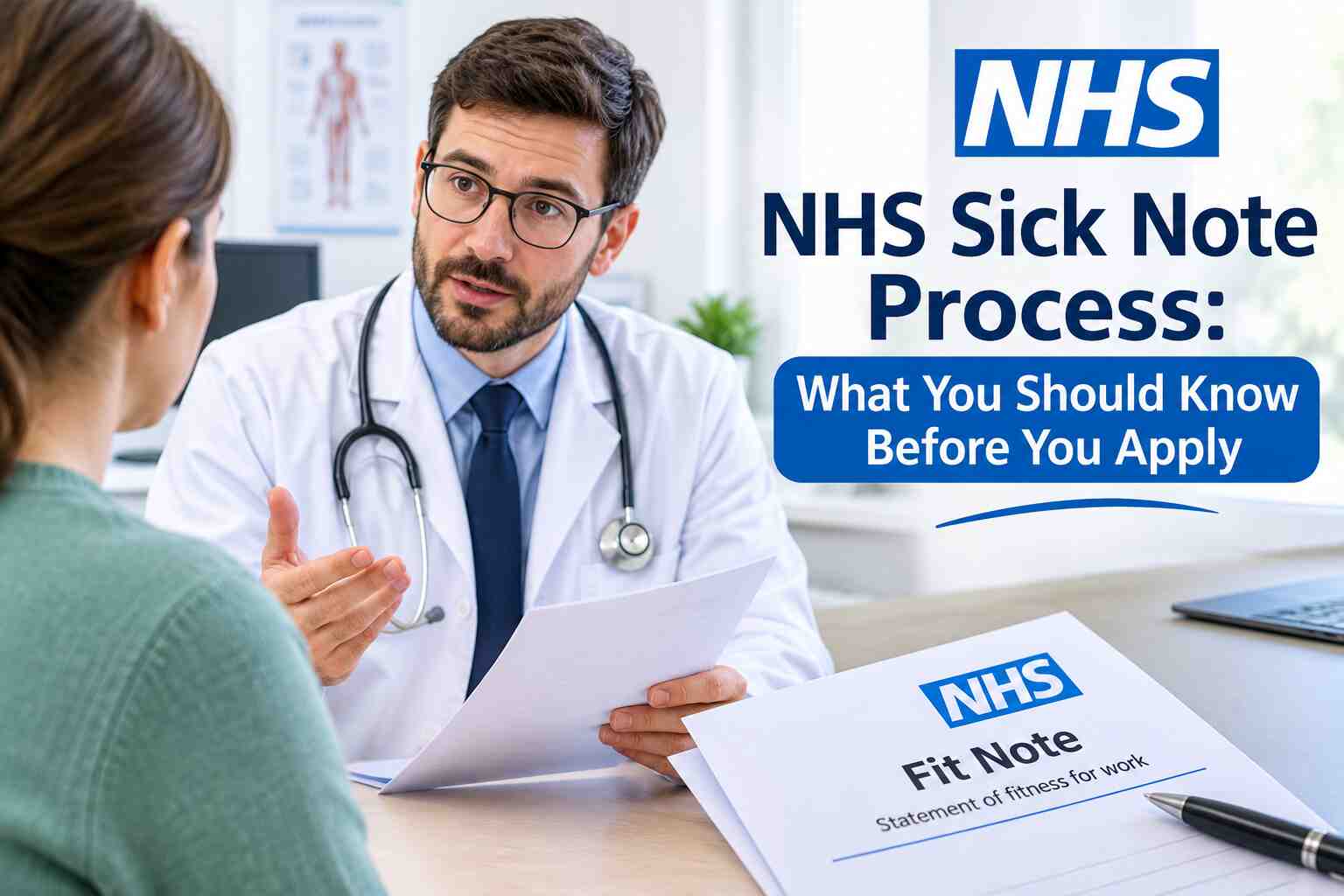
An NHS sick note, officially called a fit note, is a written statement from a healthcare professional, issued after they assess you. It records one of two outcomes: “not fit for work” or “may be fit for work”. Your employer uses it as evidence of illness, mainly for sick pay.
There is no separate “NHS” version of the document. People search for “NHS sick note” because they are asking their NHS GP practice for the standard fit note.
According to the NHS, a fit note can be issued by:
The assessment can be in person or by phone, so a surgery visit is not always needed.
A fit note covers fitness for work. If your child is off school, follow the school’s own absence policy instead.
The rule depends on how many days in a row you have been ill.
| Days off sick (in a row) | What you need | Who pays for any note |
|---|---|---|
| 1 to 7 | Self-certification. Your employer may ask you to confirm you were ill, usually by form or email | If you ask for proof from a healthcare professional, a fee can apply, and the NHS says your employer should pay it |
| 8 or more | A fit note from a healthcare professional | Free |
A worked example. You fall ill on Monday 16 November. That is day 1. Day 7 is Sunday 22 November, so you need a fit note from Monday 23 November.
Start the process before that day, not on it. If your surgery has a wait for appointments, ask on day 5 or 6.
Sources: NHS, GOV.UK. For the full rules, see our complete guide to GP sick notes.
The NHS App route is described on the NHS App help page. It does not say what a practice will charge, so ask your own surgery.
The clinician decides between “not fit” and “may be fit” based on what your condition stops you doing at work. A few minutes of preparation makes that decision more accurate.
A simple way to organise this is task, limit, change. For each part of your job, say what you cannot do and what would let you do some of it. These are illustrative examples:
| Task | What you cannot do now | A change that could help |
|---|---|---|
| Lifting stock | Anything over a few kilos | Amended duties |
| Full-day desk work | More than short spells at a screen | Altered hours or more breaks |
| Long commute | Travelling in rush hour | Working from home |
The note has one of two outcomes, and many people only expect the first.
| Not fit for work | May be fit for work | |
|---|---|---|
| Meaning | You cannot work for the period stated | You may be able to work with support |
| What it states | How long you cannot work, and whether you can return to your previous role after | Tick-box adjustments and a comment box on your general fitness for work |
| What your employer does | Treats it as evidence for sick pay | Discusses the suggested changes with you |
The adjustments on a “may be fit” note are:
Your employer must consider this advice but does not have to accept it. If you cannot agree on changes, you are treated as “not fit for work”, and the same note still counts as evidence for sick pay. This is set out in GOV.UK guidance for employers.
In the first six months of a condition, one fit note covers a maximum of three months.
It costs nothing if you have been off sick for more than seven days when you ask for it.
The first seven days are different. You do not need a fit note then, but if your employer asks for proof from a healthcare professional, a fee can apply. NHS guidance says your employer should pay it, and GOV.UK says a fee may apply for seven days or less.
Practices and private services set their own fees for non-NHS paperwork, so ask for the price before you book.
Give your employer a copy and keep the original. Your employer can keep a copy, must keep your health information confidential, and, according to GOV.UK, cannot require medical evidence beyond the fit note itself.
Sick pay changed on 6 April 2026. Under the updated Statutory Sick Pay rules:
Check your contract too. Some employers pay more than SSP.
If you receive a “may be fit” note, your employer should talk to you about the changes it suggests. They are not obliged to agree to all of them, and dismissal is a last resort that should follow proper procedures.
A delay at your surgery does not have to leave you without a note. Your options:
How do I get an NHS sick note? Contact your GP practice once you have been ill for more than seven days. A doctor, nurse, pharmacist, physiotherapist or occupational therapist assesses you, in person or by phone, and issues a fit note if you are not fit for work or may be fit with changes.
Can I get an NHS sick note online? Often, yes. If your surgery offers it, the NHS App lets you select Appointments, then Request a letter or information. Many practices also have a request form on their own website. If yours does not, contact the surgery directly.
Do I need a sick note for one day off? No. For seven days or less you self-certify, and no fit note or other healthcare proof is needed. Your employer may ask you to confirm your illness when you return, usually by form or email.
Is an NHS sick note free? Yes, if you have been off sick for more than seven days. For the first seven days, a fee can apply if your employer asks for healthcare proof, and the NHS says the employer should pay it.
Can I get a sick note without seeing a GP? Yes. Other healthcare professionals can issue fit notes, and the assessment can be by phone. You still need an assessment, because a note cannot be issued without one.
How long can a fit note cover? In the first six months of a condition, up to three months at a time. A review date can be set earlier if your condition is likely to change.
What if my sick note says “may be fit for work”? Your employer should discuss the suggested changes with you, such as phased return, altered hours, amended duties or working from home. If you cannot agree, you are treated as “not fit for work” and the same note counts as evidence for sick pay.
Will I get sick pay? If you qualify, Statutory Sick Pay is payable from day one since 6 April 2026. It is the lower of 80% of your average weekly earnings or £123.25 a week. Your contract may pay more.
Medically reviewed by Dr Sulaiman Shah, MBChB BMedSci, MRCGP — General Practitioner and founder of The GP Clinic. Last updated 11 November 2026.