Last updated: 10 November 2026 | Reviewed by Dr Sulaiman Shah, GP (GMC No. 7038832). Facts checked against GOV.UK and TravelHealthPro (UKHSA-backed) guidance.
Packing medicine for a trip abroad is not as simple as throwing a box in your bag. Rules differ between countries, airports and types of medicine, and a missing document can mean delays, questions at security or, in the worst cases, medicine being confiscated. So do you actually need a doctor’s letter? This guide explains what the UK rules say, which medicines need extra paperwork, what the letter should include and how to get one quickly.
Short answer: There is no single UK law that says every traveller needs a doctor’s letter. But UK travel-health guidance advises carrying a letter from your prescriber and a copy of your prescription, and you do need proof for some medicines. At UK airport security, you need proof that liquid medicine in a container over 100ml is prescribed to you. If you travel with medicine that contains a controlled drug, you must be able to prove it is yours, and a personal licence is needed for 3 months’ supply or more.
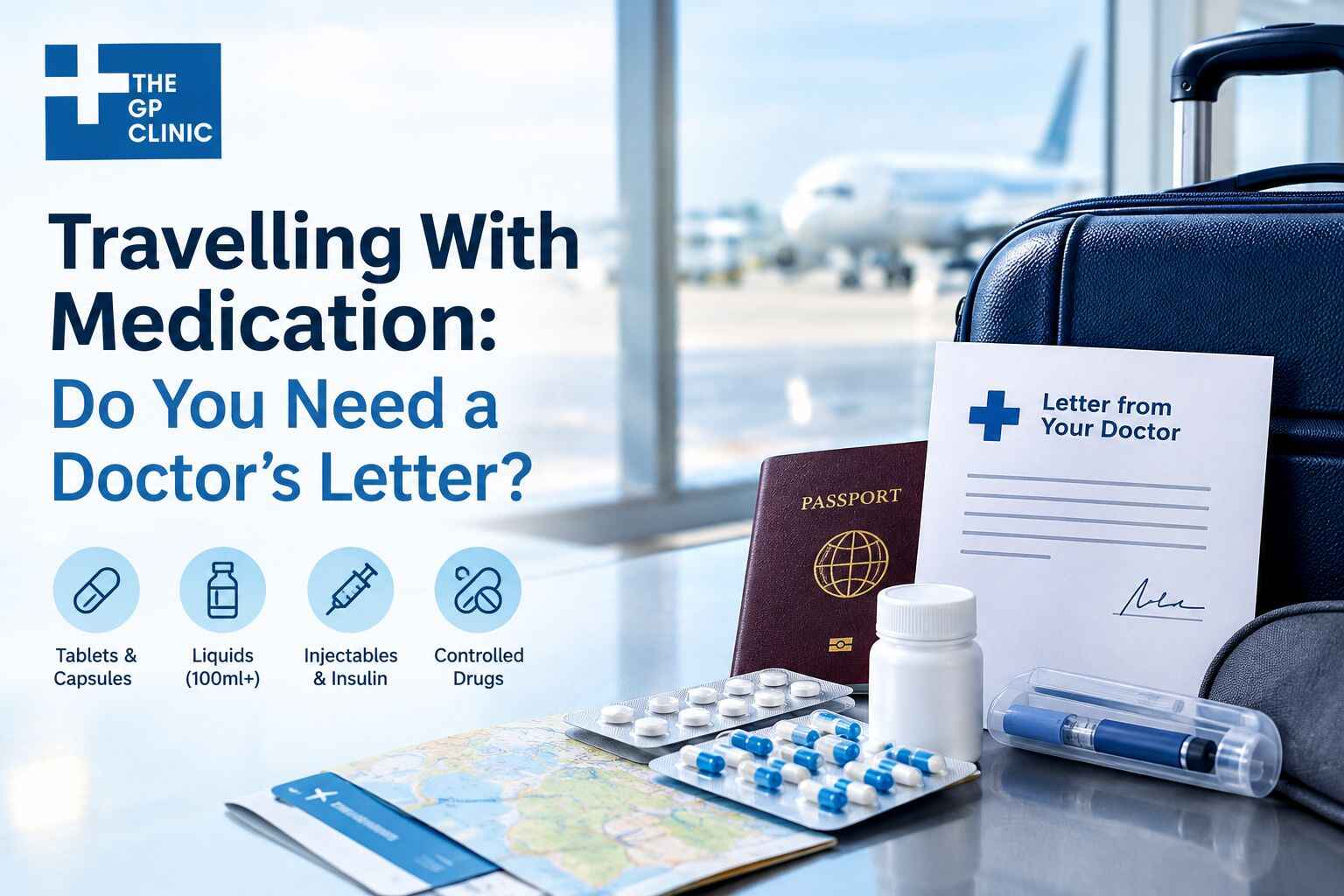
It depends on the medicine and where you are going. The National Travel Health Network and Centre (NaTHNaC), which runs TravelHealthPro, says the rules on carrying a doctor’s letter vary widely between countries and are often not consistently enforced. Its advice is to take your medicine in its original pharmacy packaging, carry a copy of your prescription, and carry a letter from the prescriber that lists your medicines by their generic names. A letter can help at border checks and if you need to replace medicine or get medical help abroad.
The table shows what applies in common situations.
| Your situation | Do you need a letter? | What else to know |
|---|---|---|
| Tablets or capsules (not controlled) | Not required at UK airport security. Advised for border checks abroad. | Keep them in original packaging in your hand luggage. Check your destination’s rules. |
| Liquid medicine in a container over 100ml | Yes, you need proof it is prescribed to you: a doctor’s letter or a copy of your prescription. | Security staff may open the container to screen it. |
| Insulin, needles, syringes, pumps | Strongly advised. TravelHealthPro advises a prescriber’s note on letterhead for injectable medicines. | Hypodermic syringes are allowed in hand luggage. Contact your airline in advance about insulin and other injectables. |
| Medicine containing a controlled drug, under 3 months | You must be able to prove it is yours with a prescription or a letter from your clinician. | Carry it in hand luggage. Check destination rules with the embassy. |
| Controlled drug, 3 months’ supply or more | Yes, plus a Home Office personal licence. | Apply early. TravelHealthPro says at least 10 days before travel. |
| CBD or medicinal cannabis | A letter does not make it legal abroad. | Many countries ban these. Some treat any cannabis-related product with zero tolerance, even in transit. |
| Over-the-counter medicines | Not usually, but some are restricted abroad. | Check the destination’s rules, because they can apply to medicines you can buy in UK shops. |
Controlled drugs are medicines the law regulates because they can be misused. TravelHealthPro’s examples include diamorphine, diazepam, codeine, fentanyl, methadone, morphine, pethidine, methylphenidate (Ritalin) and temazepam. Many strong painkillers, some ADHD medicines and some sleep and anxiety medicines fall into this group. Ask your doctor or pharmacist if you are unsure, or check the controlled drugs list on GOV.UK.
GOV.UK says you must carry medicine containing a controlled drug in your hand luggage when you enter or leave the UK, and that it may be taken from you at the border if you cannot prove it was prescribed to you. When leaving the UK, you prove it with a prescription or a letter from your clinician. The Home Office advises people travelling for shorter trips to carry a letter detailing the medicines.
The 3-month rule: If you are taking, or travelling for, 3 months’ supply or more of a controlled drug, you need a personal licence from the Home Office. The Drug and Firearms Licensing Unit can advise at dflu.ie@homeoffice.gov.uk or on 0300 105 0248. Controlled drugs in the UK are generally controlled abroad too, and some countries are stricter, so check with the embassy of the country you are visiting.
GOV.UK says you can carry essential medicines of more than 100ml in hand luggage, including liquid dietary foodstuffs and inhalers, and essential medical equipment. If the medicine is a liquid in a container over 100ml, you must carry proof that it is prescribed to you, such as a letter from your doctor or a copy of your prescription. You do not need proof for tablets or for liquids in containers of 100ml or less. Airport staff may need to open containers to screen liquids.
These items are allowed in both hand and hold luggage: tablets and capsules, essential liquid medicines, hypodermic syringes, inhalers, cooling gel packs and essential medical equipment such as CPAP machines. Ice packs and oxygen cylinders have separate rules, so contact your airport or airline.
The letter should come from a doctor on headed paper and be signed and dated. GOV.UK’s guidance on the letter for people bringing medicine into the UK gives a good model, and NaTHNaC advises using generic medicine names.
| Detail | Why it matters |
|---|---|
| Your full name and date of birth | Links the letter to your passport and prescription. |
| Each medicine’s generic name, strength and dose | Brand names differ between countries, so generic names help officials and foreign doctors. |
| The quantity you are carrying | Shows you are within the limits and carrying only what you need. |
| Travel dates and destination(s) | Shows the supply matches the trip. Include any stopovers. |
| A statement that the medicines are prescribed for your personal use | Distinguishes personal medicine from trafficking. |
| The doctor’s name, GMC number, signature, date and contact details | Lets officials verify the letter. |
| Equipment (needles, syringes, pumps), if relevant | Explains why you are carrying them. |
You decide whether the letter states your medical condition. Some travellers prefer to include it so officials understand why they need the medicine, while others prefer to keep it private. Discuss this with the doctor. If the letter is not in English, you may want a translation for your destination.
The NHS accepts responsibility for supplying enough ongoing medication for temporary periods abroad of up to three months. For trips of any length, pack enough for the whole journey plus extra for delays or lost luggage. TravelHealthPro advises keeping medicine in hand luggage, with some extra in the hold in case your hand luggage is lost or stolen. If you plan to be away for longer than three months, check how you will get your medicines in the country you are visiting, because the NHS will not usually supply more.
This is the step travellers skip most often. Some countries do not allow certain medicines at all, and others require specific permission, even for medicines you can buy over the counter in the UK. The medicine in your bag may also be a different strength or formulation abroad.
The best source is usually the doctor or specialist who prescribes the medicine, because they hold your records. NaTHNaC advises a letter from the prescriber. In practice, NHS practices treat travel letters as private work, often charge a fee, and can take time, so ask well ahead of your trip. Some charities advise asking at least three weeks before you travel.
If you cannot get a letter from your own prescriber in time, you can speak to a GMC-registered GP online. At The GP Clinic, a Travel with Medication Letter costs £39 and is included with the consultation when the doctor can clinically support it. Video appointments are available 365 days a year, and you can often speak to a doctor in as little as 30 minutes.
The doctor needs to review proof that the medicine has been prescribed to you. This can be a pharmacy label on the medicine box, a prescription receipt, or your NHS Summary Care Record or details from the NHS App. The clinic does not prescribe controlled drugs, including benzodiazepines, strong painkillers and ADHD medicines, so it cannot supply extra medicine for your trip. If you already have a prescription for a controlled drug, the doctor can review your proof and, where clinically appropriate, write a letter with details such as dose, quantity and travel dates. A Home Office personal licence, needed for 3 months’ supply or more, is a separate process, so speak to your prescriber or the Home Office early.
You must be aged 18 or over and in the UK at the time of the appointment. For a broader look at letters and certificates, see our guide to medical letters vs medical certificates. If you are pregnant and flying, read about a fit to fly letter for pregnancy.
The safest approach is to treat a doctor’s letter as part of your travel kit: original packaging, a copy of your prescription and a signed letter, all in your hand luggage. Check your destination’s rules before you pack, and give controlled drugs extra time. If you need a letter quickly and cannot get one from your own prescriber, you can speak to a GP online. Book an online GP appointment or request a Travel with Medication Letter.
This article is for general information, not medical or legal advice. Rules change and differ by country, so check GOV.UK and your destination’s embassy before you travel. In a medical emergency, call 999 or NHS 111. This service is not for emergencies.
There is no single UK rule for every medicine, but UK travel-health guidance advises carrying a prescriber’s letter and a prescription copy. You need proof for some items, such as liquid medicine over 100ml or medicine containing a controlled drug. Always check your destination’s rules.
Only in some cases. You do not need proof for tablets or for liquids in containers of 100ml or less. You do need a letter from your doctor or a copy of your prescription for liquid medicine in a container over 100ml.
Hypodermic syringes are allowed in hand and hold luggage, but a letter is strongly advised. TravelHealthPro advises a prescriber’s note on letterhead for injectable medicines. Contact your airline in advance about insulin and other injectables.
Controlled drugs include many strong painkillers, some ADHD medicines and some sedatives and sleeping medicines, such as morphine, diazepam, methylphenidate and temazepam. Ask your doctor or pharmacist if your medicine is one, and check the controlled drugs list on GOV.UK.
You need a personal licence if you are travelling with 3 months’ supply or more of a controlled drug, or travelling for 3 months or more. TravelHealthPro advises applying at least 10 days before travel. Contact the Drug and Firearms Licensing Unit if you are unsure.
The NHS supplies enough ongoing medication for temporary stays abroad of up to three months. Pack enough for the whole trip plus extra for delays or lost luggage. If you are away for longer, check how you will get your medicine at your destination.
Your name and date of birth, each medicine’s generic name, strength, dose and quantity, your travel dates and destinations, a statement that the medicine is for personal use, and the doctor’s name, GMC number, signature and contact details, on headed paper.
Yes, if the doctor can review proof that the medicine is prescribed to you, such as a pharmacy label, prescription receipt or NHS Summary Care Record, and can clinically support the letter. At The GP Clinic, a Travel with Medication Letter costs £39. The clinic does not prescribe controlled drugs, and a Home Office personal licence must be arranged separately with your prescriber or the Home Office.
NHS practices usually treat these letters as private work and charge fees that vary between practices. At The GP Clinic, a Travel with Medication Letter costs £39 and is included with the consultation, with prices correct at 10 November 2026.
Take extreme care. CBD products are legal in the UK but are banned in many countries, and some have zero tolerance for any cannabis-related product, even in transit. A doctor’s letter does not make these legal abroad, so check with the embassy before you travel.